|
|
 |
 |
 |
 |
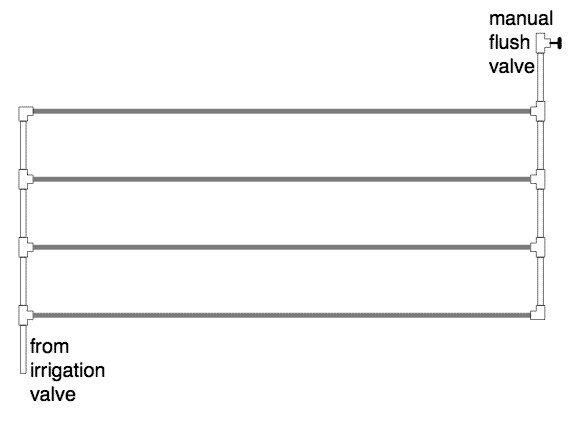
Drip IrrigationWe have an extensive list of FAQs (Frequently Asked Questions). If you have questions you don't see answered below, look for the answer in our FAQ section. Drip irrigation can be the most efficient type of irrigation, but it is not suitable for all types of landscaping, and must be designed and installed carefully. In order to allow periodic flushing of debris, the layout of a drip irrigation system must provide for a way to flush the system periodically. The supply should provide for pressure control (if incoming pressure is significantly higher than 30 psi), pressure measurement, a filter and a flush bypass. If the supply pressure is high, the pressure control should be installed just before the flow control to avoid excessive pressure drop across the flow control. One key to a successful design is one where damage to any of the drip lines will NOT result in dirt entering the lines. Drip lines are installed so shallow that they are prone to damage from digging and exposure to animals (dogs or wild animals- either way). A good drip design does not have dead ends- lines that water flows in one end and the other end is capped. In the illustration below there are no dead ends. If you were tocut any one of the drip lines, water will pour out of the line on either side of the cut. If you design a system with dead ends, acut allows dirt to enter the downstream portion of the line. With a looped design lie this, your system will be inherently able to resist entry of dirt when the lines are damaged.
You also need to supply each drip station with a separate pressure regulator and Wye filter. It is possible to put these in front of a set of valves but more commonly each station has it's own filter and regulator. Many people choose a control zone kit for this purpose. Modern driplines contain emitters that perform, to some degree, a pressure regulation in the emitter itself, but it is still important to provide overall pressure regulation at the valve. The spacing between the drip lines shold be about equal to the drip emitter spacing for even coverage. We recommend closely spaced emitters to provide more even watering. Links to continue to the next page are found at the bottom of this page.
 
| |||||||||||